13 Nov 2025
10 Best Free SCORM Software & Authoring Tools (2026)
maestro
Author

Top 10 Free SCORM Software Tools for 2026
Creating engaging online courses doesn't always require a hefty budget. If you need your eLearning content to work seamlessly with a Learning Management System (LMS) Learning Management System (LMS) and track learner progress, SCORM is the standard you'll need. Finding reliable, free SCORM authoring tools SCORM authoring tools can feel like searching for a needle in a haystack, but quality options do exist. Whether you're an instructional designer, a corporate trainer, an educator, or a small business owner dipping your toes into eLearning, the right free tool can make a big difference.
This guide provides a clear explanation of what SCORM is and why it matters. We'll set out key criteria for evaluating free software and then dive into detailed reviews of the top 10 free SCORM-compliant tools available in 2026, helping you find the best fit for your projects without breaking the bank.
What is SCORM and Why Do You Need It?
SCORM stands for Sharable Content Object Reference Model. Think of it like a universal standard for online learning content, similar to how a DVD is designed to play in any standard DVD player. SCORM ensures that an eLearning course created in one piece of software (an authoring tool) can be reliably uploaded, run, and tracked within a different piece of software (a Learning Management System, or LMS).
Why is this important?
- Interoperability: SCORM allows you to create content once and use it across various LMS platforms. You aren't locked into a single system. If you switch your LMS, your SCORM courses should still work.
- Tracking: This is the core benefit. SCORM defines a standard way for the course content to "talk" to the LMS, reporting crucial learner data like:
- Completion Status: Did the learner finish the course? (e.g., Completed/Incomplete)
- Success Status/Score: Did the learner pass or fail? What was their quiz score?
- Time Spent: How long did the learner spend in the module?
- Bookmarking: Can the learner exit and resume where they left off?
Without SCORM (or a similar standard like xAPI), your LMS might not be able to track this vital information, making it difficult to measure learning effectiveness or prove compliance.
SCORM Versions:
There are several versions, but the two you'll encounter most are:
- SCORM 1.2: An older but still very widely used standard. It has basic tracking capabilities.
- SCORM 2004: A newer set of standards (with several editions) offering more robust tracking, sequencing (controlling the order learners access content), and richer data reporting. SCORM 2004 3rd Edition is common.
Most modern LMS platforms support both versions, but SCORM 1.2 remains the most universally compatible.
What Should You Look for in Free SCORM Authoring Software?
Free doesn't always mean feature-rich or easy to use. When evaluating free SCORM tools, keep these practical points in mind:
- Ease of Use: How intuitive is the interface? Can you start creating quickly, or is there a steep learning curve requiring technical skills? Many free tools assume some level of expertise.
- Output Quality & Features: Does the software produce professional-looking courses? What types of interactivity (quizzes, simple interactions) can you build? Free tools often have limitations here.
- SCORM Conformance: Does it reliably export to SCORM 1.2 and/or SCORM 2004? Test the output in a platform like SCORM Cloud (which offers a free testing tier) to be sure.
- Tracking Capabilities: What specific data does the tool allow you to send to the LMS (completion, score, interactions)?
- Export Options: Does it only export to SCORM, or can you also publish to HTML5 for web viewing?
- Support & Community: Is there any documentation, tutorials, or an active user forum available? Free tools rarely offer direct customer support.
- Limitations & Hidden Costs: What are the restrictions? Free versions often limit the number of courses, slides, features, or branding options. Some "free" tools are actually free trials or require attribution.
Top 10 Free SCORM Authoring Tools for 2026
Here's a look at some of the best free options available, ranging from simple converters to more complex open-source projects.
Comparison: Free SCORM Tools at a Glance
| Tool Name | Platform | Type | Best For | Ease of Use | Key Limitation(s) |
|---|---|---|---|---|---|
| Compozer | Web | Freemium | Collaborative creation of responsive courses | ★★★★★ | Free plan limited (1 course, limited features) |
| iSpring Free | Desktop | Freemium | Converting PowerPoint to basic SCORM courses | ★★★★☆ | Limited interactivity, iSpring branding on output |
| Adapt Authoring Tool | Web (Self-hosted) | Open Source | Creating responsive, HTML5 scrolling courses | ★★★☆☆ | Requires technical setup, specific course format |
| H5P | Web Plugin/SaaS | Open Source/Paid | Adding interactive elements to existing sites | ★★★★☆ | Not a full course builder, SCORM needs integration |
| CourseLab | Desktop | Free (Old) | Building complex interactions (with effort) | ★★☆☆☆ | Outdated interface, steep learning curve, Windows-only |
| GLO Maker | Desktop | Free (Old) | Creating structured learning objects | ★★☆☆☆ | Outdated, limited features, Windows-only |
| isEazy Author | Web | Freemium | Quick creation of modern-looking courses | ★★★★☆ | Free plan very limited (1 course, basic features) |
| Easygenerator | Web | Freemium | Simple course creation for non-designers | ★★★★☆ | Free plan highly restricted (features, SCORM export) |
| Coassemble | Web | Freemium (Trial) | All-in-one authoring & LMS for teams | ★★★★☆ | Free is a trial, not a permanent free plan |
| Oppia | Web (Self-hosted) | Open Source | Creating interactive, conversational lessons | ★★★☆☆ | Requires technical setup, focus on specific format |
(Ease of Use: ★ = Very Difficult, ★★★★★ = Very Easy)
Detailed Tool Reviews
Compozer
Platform: Web (Cloud-based / SaaS)
Type: Freemium
Best For: Educators, trainers, instructional designers, and businesses seeking a collaborative, user-friendly tool to create responsive, visually engaging, and interactive e-learning content.
Ease of Use: ★★★★★ (Easy) it is "incredibly user-friendly", "intuitive", and has a "small" learning curve.
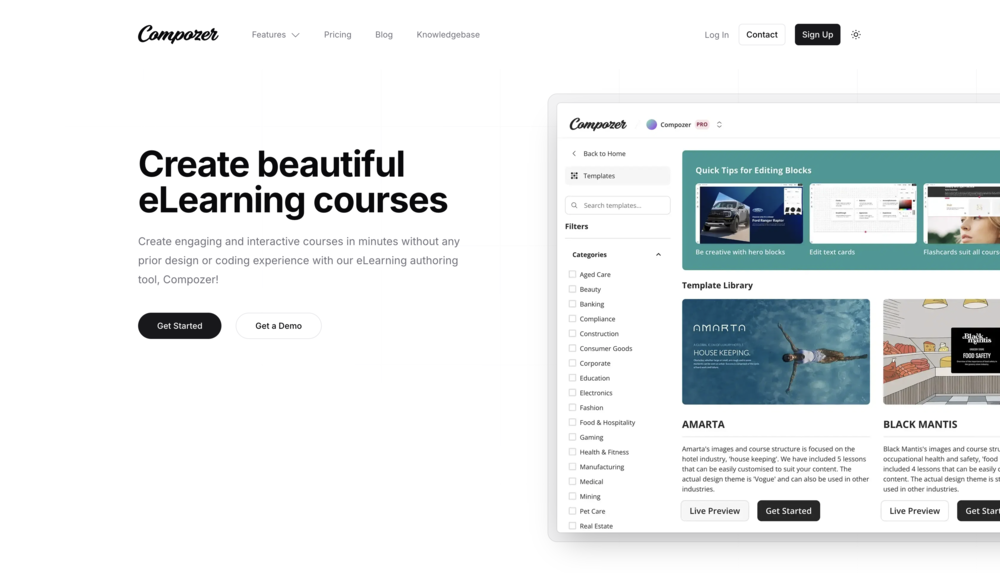
Description: Compozer is a user-friendly, cloud-based authoring tool with over 100 professionally designed templates and team collaboration features. It focuses on creating responsive, mobile-optimized courses that are compliant with SCORM SCORM (including 1.2 and 2004) and xAPI for publishing to an LMS.
Key Limitation(s): The Freemium plan is limited to one course creation and does not include the quiz, branding, or white-labeling features. Under its listed features, the platform also notes that API, a Mobile App, and Third Party Integrations are "Not Available".
iSpring Free
Platform: Desktop (Windows)
Type: Freemium (Free version available)
Best For: Quickly converting existing PowerPoint presentations into basic SCORM 1.2 or 2004 courses.
Ease of Use: ★★★★☆ (Very easy if you know PowerPoint)
Description: iSpring Free installs as a PowerPoint add-in. You create your slides in PowerPoint, then use the iSpring tab to add a simple quiz (multiple choice, multiple response, short answer) and publish directly to SCORM. It's incredibly straightforward for basic needs.
Key Limitation(s): The free version adds an iSpring watermark/branding to the output. It only supports very basic quiz types and no complex interactions.
Adapt Authoring Tool
Platform: Web (Requires self-hosting or a provider)
Type: Open Source (Free)
Best For: Creating modern, fully responsive (HTML5), single-page scrolling courses that look great on mobile devices.
Ease of Use: ★★★☆☆ (Moderate - setup requires technical skills, authoring is visual)
Description: Adapt is a powerful framework for building "mobile-first" eLearning. The authoring tool provides a visual interface for assembling courses using pre-built components (text, graphics, simple interactions). It exports to SCORM 1.2/2004.
Key Limitation(s): Requires server setup (Node.js) or finding a hosting provider. Less flexible for traditional slide-based designs. Community support only.
H5P
Platform: Web Plugin (WordPress, Moodle, Drupal) or SaaS (H5P.com)
Type: Open Source (Free plugin) / Paid SaaS
Best For: Adding a wide variety of interactive elements (quizzes, interactive videos, flashcards, drag-and-drops) to existing websites or LMS courses.
Ease of Use: ★★★★☆ (Relatively easy to create content types)
Description: H5P allows you to create over 40 different types of interactive HTML5 content. While not a full SCORM authoring tool on its own, many integrations (like the Moodle plugin or specific WordPress plugins) allow you to embed H5P activities within a course structure that can then report SCORM data (usually completion) to an LMS.
Key Limitation(s): Doesn't create standalone SCORM packages directly; relies on integration with another platform for SCORM tracking. Tracking details can be limited depending on the integration.
CourseLab
Platform: Desktop (Windows)
Type: Free (Older software, version 2.4 is free)
Best For: Building complex, simulation-style interactions if you're willing to learn its dated interface.
Ease of Use: ★★☆☆☆ (Difficult, steep learning curve)
Description: CourseLab was once a powerful commercial tool, and an older version remains free. It offers object-oriented authoring, allowing for very complex custom interactions without coding. It exports to SCORM 1.2/2004.
Key Limitation(s): The interface is very outdated and unintuitive compared to modern tools. It hasn't been updated in years, compatibility issues may arise, and there's no official support. Windows-only.
GLO Maker
Platform: Desktop (Windows)
Type: Free (Older software)
Best For: Creating structured, reusable "Generative Learning Objects" based on pedagogical patterns.
Ease of Use: ★★☆☆☆ (Moderate difficulty, specific workflow)
Description: GLO Maker is an open-source tool developed for educational purposes. It guides authors through creating learning objects based on specific instructional design patterns (e.g., concept maps, timelines). Exports to SCORM 1.2.
Key Limitation(s): Outdated interface, limited flexibility outside its structured patterns, limited interactivity types, no longer actively developed. Windows-only.
isEazy Author
Platform: Web (Cloud-based)
Type: Freemium
Best For: Quickly creating visually appealing, modern-looking slide-based courses with basic interactivity.
Ease of Use: ★★★★☆ (Very easy)
Description: isEazy Author offers a clean, intuitive drag-and-drop interface and nice templates. It allows for creating responsive courses with elements like image carousels, hotspots, and simple quizzes.
Key Limitation(s): The free plan is very limited: you can only create 1 course project (up to 10 slides), collaboration is disabled, and SCORM export is basic (SCORM 1.2 only, limited tracking).
Easygenerator
Platform: Web (Cloud-based)
Type: Freemium
Best For: Subject matter experts or non-designers needing a very simple way to create basic courses.
Ease of Use: ★★★★☆ (Very easy)
Description: Easygenerator focuses on simplicity with a straightforward authoring process. You add content blocks (text, image, video, simple questions) to create pages.
Key Limitation(s): The free plan is essentially a trial with severe restrictions. You cannot export to SCORM, can only have 1 author and 1 course, and many features are locked. A paid plan is necessary for practical SCORM use.
Coassemble (Formerly eCoach)
Platform: Web (Cloud-based)
Type: Freemium (Free Trial, then paid)
Best For: Teams looking for an integrated authoring tool and LMS platform with a focus on simplicity and user experience.
Ease of Use: ★★★★☆ (Very easy)
Description: Coassemble combines course creation with LMS features. The authoring interface is template-driven and user-friendly, producing modern-looking courses. It exports to SCORM 1.2/2004.
Key Limitation(s): The "free" aspect is typically a limited-time free trial, not a permanently free plan for creating SCORM content. Long-term use requires a paid subscription.
Oppia
Platform: Web (Requires self-hosting or use on Oppia.org)
Type: Open Source (Free)
Best For: Creating interactive, conversational, tutor-style lessons.
Ease of Use: ★★★☆☆ (Moderate - Authoring is guided, setup requires technical skills)
Description: Oppia allows creators to build interactive "explorations" that simulate a conversation, providing feedback and guidance based on learner input. While primarily web-based, technically advanced users might be able to package content for SCORM, but it's not a primary feature.
Key Limitation(s): SCORM export is not a native, straightforward feature and may require custom development. Requires technical setup for self-hosting. Focuses on a specific lesson format.
Should You Consider a Paid Tool Instead?
Free tools are great for simple projects, testing SCORM concepts, or occasional use. However, you'll likely hit limitations quickly if you're creating courses professionally or for an organization. Consider a paid tool if you need:
- Professional Support: Free tools offer little to no direct support. Paid tools provide customer service, technical help, and training resources.
- Advanced Features & Interactivity: Paid tools offer far more quiz types, variables, branching scenarios, simulations, and sophisticated interactions.
- Collaboration & Review: Paid cloud-based tools often include features for multiple authors to work together and for stakeholders to review and comment directly on courses.
- Templates & Assets: Paid tools usually come with large libraries of professional templates, characters, stock images, and icons, saving significant design time.
- Reliability & Updates: Paid software is actively maintained, updated for compatibility, and generally more stable.
- Advanced Tracking & Analytics: Paid tools often offer more granular tracking options beyond basic completion and score.
- No Branding/Watermarks: Paid tools allow full white-labeling with your organization's branding.
If your projects are complex, require collaboration, need robust features, or if you simply value dedicated support, investing in a paid authoring tool (like Articulate Storyline/Rise 360, Adobe Captivate, iSpring Suite, or paid plans of freemium tools like isEazy or Compozer) is often more efficient and effective in the long run.
Conclusion
The "best" free tool ultimately depends on your specific needs, technical comfort level, and the complexity of your project. If you're just starting, need basic SCORM output, or are working on a personal project, these free options are worth exploring. Start by trying one or two that seem to fit your workflow – you might find exactly what you need without opening your wallet. However, be realistic about their limitations and consider graduating to a paid tool as your requirements grow.
Frequently Asked Questions (FAQs)
How to convert PPT to SCORM free?
The easiest way is using iSpring Free. Install it, open your PowerPoint presentation, and use the iSpring tab to publish it as a SCORM package. Remember the free version adds iSpring branding.
Is SCORM Cloud free?
SCORM Cloud offers a generous free testing plan. You can upload SCORM packages (up to 100MB each), test their conformance, launch them, and see how they report data. It's an essential tool for developers, but it's not a free authoring tool or a free LMS for large-scale delivery.
What software creates SCORM files?
SCORM files (packages) are created by eLearning authoring tools. This includes free tools like those listed above, as well as popular paid software like Articulate Storyline 360, Articulate Rise 360, Adobe Captivate, iSpring Suite, Lectora, and many others.
Is Canva SCORM compliant?
No, Canva is primarily a graphic design tool. While you can create presentations or documents in Canva, it does not have a built-in function to export content as a SCORM package that tracks learner progress in an LMS.
Can I make SCORM content without any software?
Technically, yes, but it's highly impractical for most people. Creating a SCORM package involves writing specific XML files (like the imsmanifest.xml), JavaScript API calls, and structuring content files correctly according to the standard. This requires significant technical knowledge. Authoring software automates this complex process.
Is SCORM the same as an LMS?
No. SCORM is a standard or set of rules for how learning content should be packaged and communicate. An LMS (Learning Management System) is the software platform that hosts, delivers, and tracks that SCORM content (and other learning materials). The LMS reads the SCORM package and uses the standard to monitor the learner's interaction.
Can I upload a SCORM package to a regular website?
You can upload the zipped SCORM file, but a regular website won't know what to do with it. To play the SCORM course and track the data, you need a SCORM-compliant player, which is typically built into an LMS. Simply linking to the index.html file within the package might launch the course, but no tracking data will be saved.
What is the difference between SCORM 1.2 and SCORM 2004?
SCORM 1.2 is simpler and tracks basic data like completion status (incomplete/complete/passed/failed), score, and time. SCORM 2004 is more complex, offers more detailed tracking (like interactions with individual questions), separates completion and success status (e.g., someone can complete a course but still fail), and includes sequencing rules to control navigation between modules. SCORM 1.2 is more widely compatible, while SCORM 2004 offers richer capabilities.
Are there any free open-source LMS platforms?
Yes, several popular open-source LMS platforms are free to download and use (though they require hosting and technical setup). The most well-known is Moodle. Others include Canvas LMS (has an open-source version), Sakai, ILIAS, and Open edX.